Alfred Currier · Oil Impasto Painter · Currently at JG Art Gallery
Alfred Currier was born in 1943 in New Jersey and grew up in Ohio. He received his formal education at the Columbus College of Art & Design in Ohio and the American Academy of Art in Chicago, where he earned his degree in Fine Arts, and also trained at the Palette and Chisel Academy of Fine Art in Chicago. Early in his career he taught figure painting and led plein air workshops across the United States and Europe. In 1991 he relocated to Anacortes, Washington, where he has painted ever since from a studio in a restored 1891 church building two blocks off the main street of town.
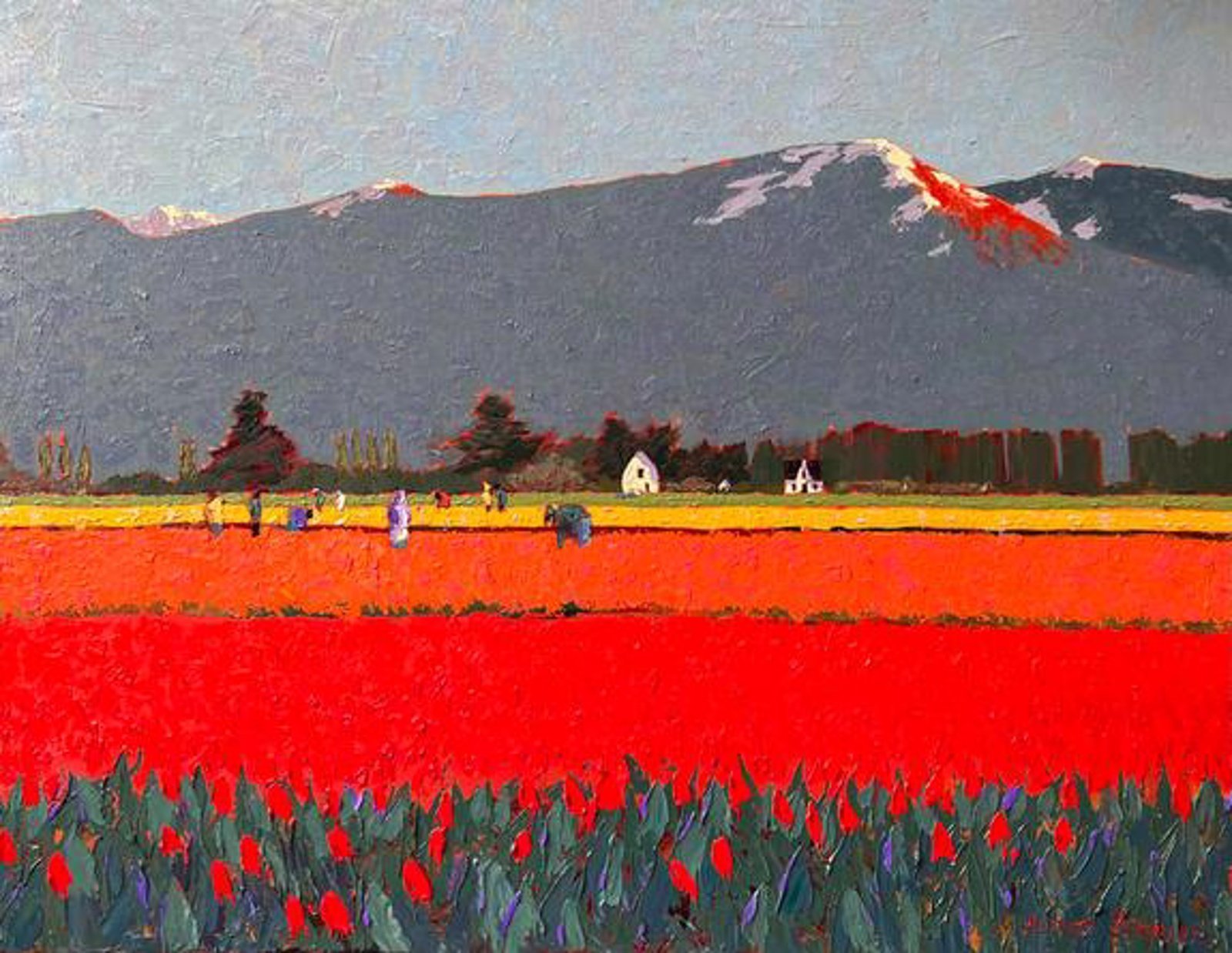
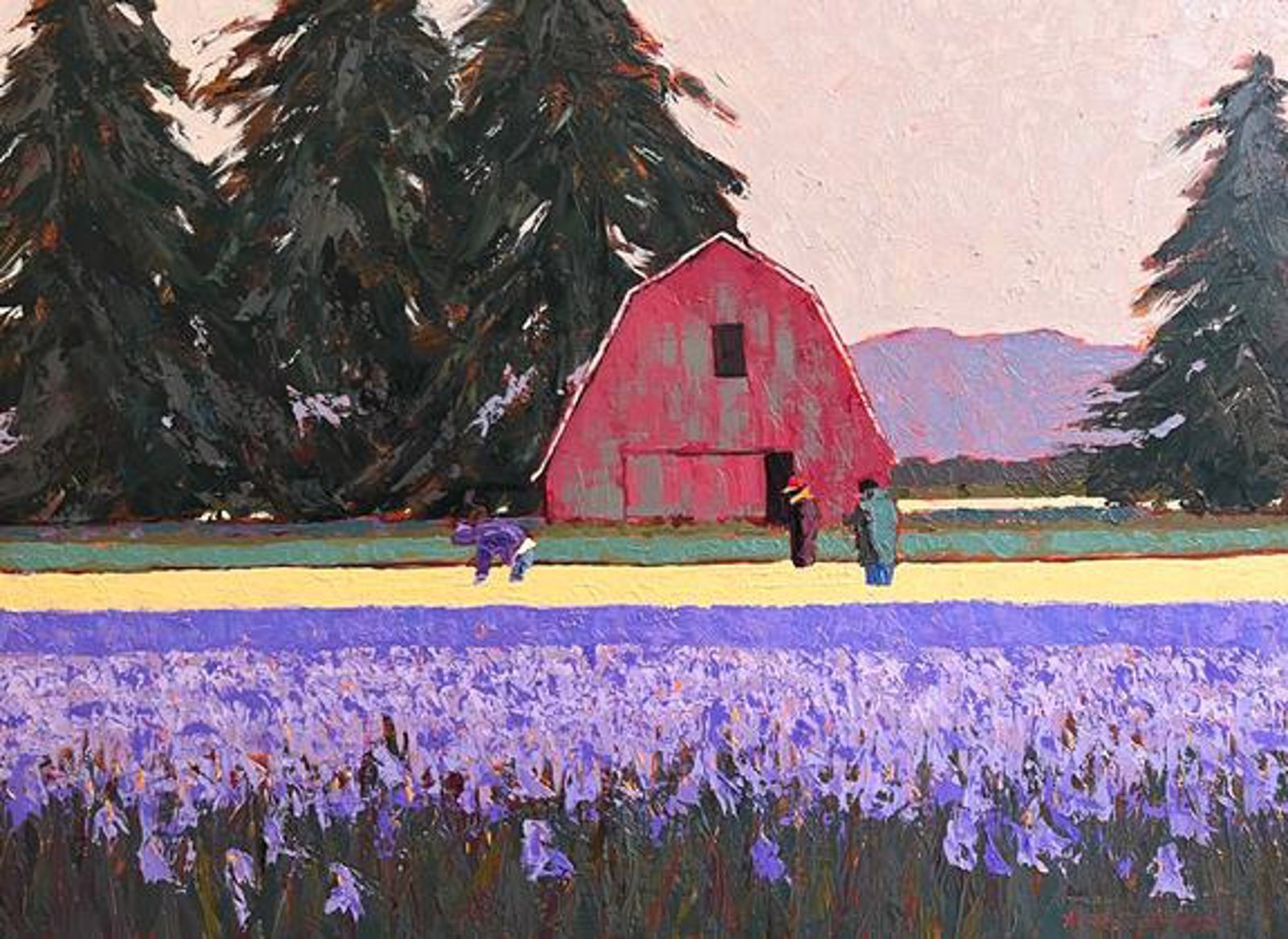
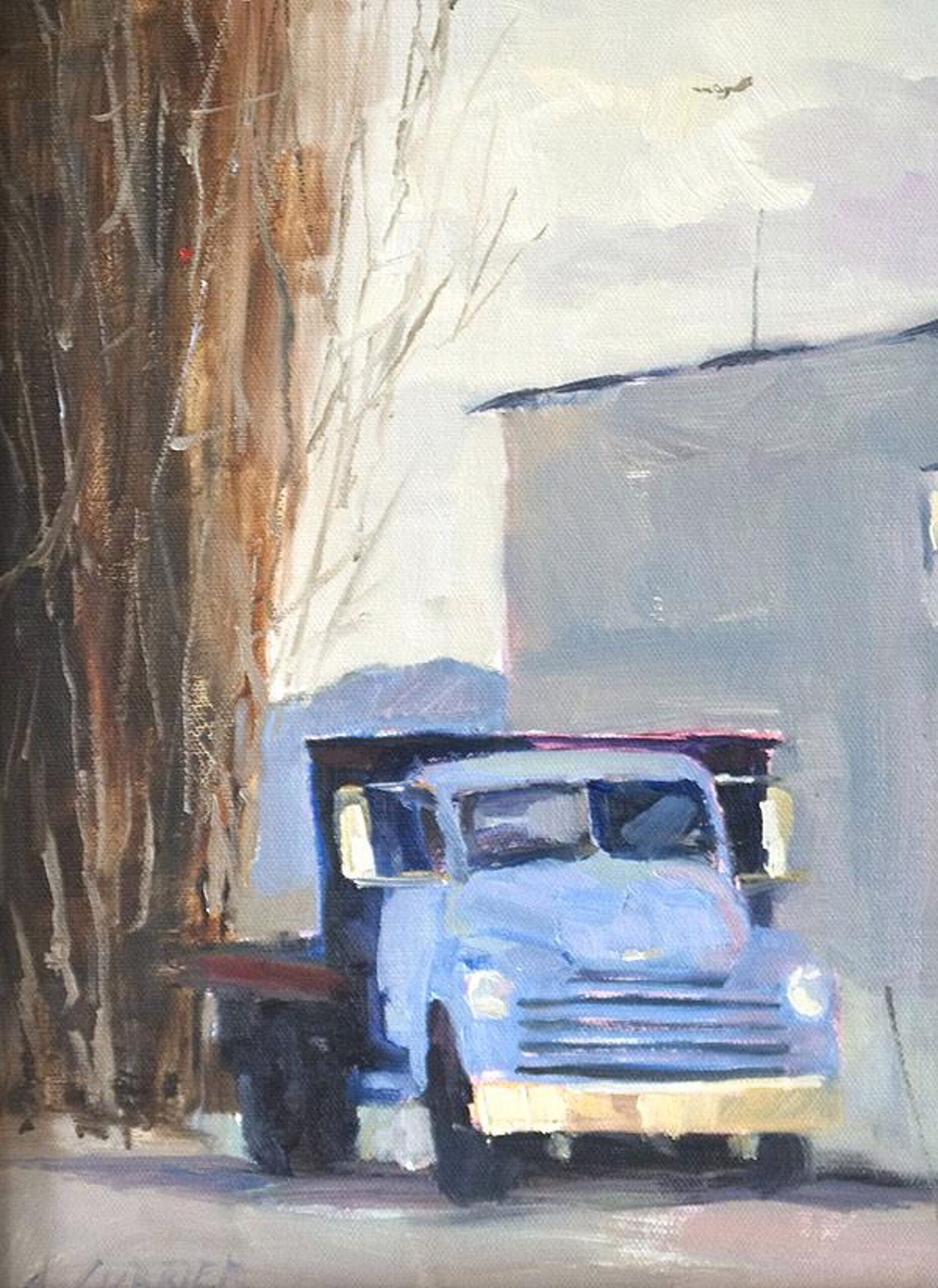
His medium is oil impasto — thick, heavily loaded passages built up with brush and knife, often accented with red outlining that sets forms against surrounding color. He sketches subjects en plein air, frequently sitting on an upturned five-gallon bucket in the Skagit Valley fields, then returns to the studio to paint. The compositions resist direct transcription: “truth is more feeling than fact.” Color complements are set against each other for tension rather than the saturated, monochromatic tones more common in Northwest painting. In April Bloom, Currier constructs his tulip field through bold loaded-brush application in cadmium red and viridian, the pigment layered so thickly that individual strokes remain visible as sculptural ridges across the canvas. The composition uses atmospheric perspective—ochre and zinc white receding toward snow-capped peaks—yet the foreground's aggressive impasto contradicts spatial recession, creating a jarring flatness that undermines the landscape's illusionistic depth. The work's heavy-handed romanticism, reinforced by the anecdotal farmhouse and laborers, risks descending into postcard sentimentality, saved only by the painting's frank acknowledgment of its own material excess. In Just Curious, Currier builds his pastoral scene through assertive loaded-brush strokes in cadmium red and viridian, layering the foreground poppies with visible gestural marks that subordinate botanical accuracy to chromatic drama. The composition positions the solitary cow as a compositional anchor between the red barn and distant hills, using atmospheric recession to organize three distinct spatial zones, though the flattened perspective undercuts the landscape's classical depth. The work risks didacticism through its American Gothic legibility—the symbolic alignment of animal, structure, and nature reads almost as checklist sentimentality rather than formal inquiry. In Tracks, Currier's composition uses a bold stratification—foreground flowers rendered in zinc white impasto against a cadmium red field that dominates the middle distance, with viridian and burnt sienna trees anchoring the horizon beneath a slate blue sky. The truck and figure are depicted with loaded brushwork in ochre and cream, their forms deliberately simplified to compete with rather than recede into the surrounding landscape. The thick red outline separating planes reads as both boundary and assertion, a risk that verges on graphic design but ultimately tethers the painting to its agricultural subject rather than allowing it to dissolve into abstraction. The Skagit Valley's tulip fields and their migrant workers are recurring motifs — his painting Hansa Tulips was chosen as the official 1998 Skagit Tulip Festival poster.
The University of Washington Press, in association with Marquand Books, published Alfred Currier: Impasto, written by Ted Lindberg, former Curator of the Vancouver Art Museum. Currier was the cover artist for American Artist Magazine and has been the subject of numerous articles and gallery retrospectives. He has painted on location in Greece, France, Italy, Holland, Argentina, Mexico, Hawaii, Alaska, and Glacier National Park. His work is held in private and corporate collections across the United States, Europe, and Japan, and is in the Washington State Art Collection.
For me, art has been an obsession as well as a passion. Passion would be for the love of it. Obsession means you have no choice. My work takes on two different faces, plein air and impasto. The plein air aspect keeps my technical painting skills freshly honed, giving me the tools in my toolbox. Impasto studio painting, on the other hand, is my more creative side as it allows me to explore texture and color from imagination.
Alfred's practice, in detail.
Education & Formation
- 1943Born — New Jersey; raised in Ohio
- DegreeColumbus College of Art & Design — Ohio
- DegreeAmerican Academy of Art — Chicago, ILFine Arts degree
- TrainingPalette and Chisel Academy of Fine Art — Chicago
- TeachingFigure painting instructor · plein air workshopsUSA and Europe — early career
- 1991Relocated to Anacortes, WashingtonStudio in restored 1891 church building
Publications & Press
- Book"Alfred Currier: Impasto" — University of Washington Press / Marquand BooksWritten by Ted Lindberg, former Curator, Vancouver Art Museum
- MagazineCover artist — American Artist Magazine
- 2001"A Painter Looks at Photography" — Lens Work periodical, Jan–Feb 2001
- PosterHansa Tulips — official 1998 Skagit Tulip Festival poster
International Plein Air
- EuropeGreece · France · Italy · Holland
- AmericasArgentina · Mexico · Hawaii · AlaskaSanta Fe · Taos · Santa Barbara · Laguna Beach
- PNWSan Juan Islands · Glacier National Park · Skagit ValleyTulip fields and migrant workers as primary subject
Collections
- PublicWashington State Art Collection
- PrivatePrivate and corporate collections — USA, Europe, JapanSince 1991
Practice
- TechniqueOil impasto — thick loaded brush and palette knifeRed outlining as signature — accents forms against surrounding color
- ProcessPlein air sketching → studio paintingOften sketches seated on upturned 5-gallon bucket in field
- PaletteColor complements for tension, not monochromatic saturationPinks · yellows · mauves · cadmium reds · burnt orange · violet
Works at JG
- Range18 works — landscapes, skyscapes, figures, birdsApril Bloom · Just Curious · Rest Stop · El Iris · Tracks · Take Off · Sunburst
As featured in.
Selected works.
A current selection from Alfred's work, available through JG Art Gallery. The gallery responds within one business day with placement, dimensions, and indicated price for the work in question.
The gallery responds within one business day.
For current availability, pricing, or to commission new work, write directly. Worldwide shipping, payment plans, full provenance documentation.